30/09/2014

Doctor Who: The Executive Producers

By now you should know that I am quite the Whovian. I, like so many millions around the world love watching and reveling in the weekly adventures of our favourite Time Lord, and long may his reign on our Saturday night screens continue! But I got to thinking...what about taking a look at the minds leading this modern day Who? Since it's revival nine years ago, there have been two Executive Producers/Head Writers to take the helm, and the results in style, overall outcome and feel of the show have been markedly different. So here's a few words from me on what I think of each...


RUSSELL T DAVIES
2005-2010


Often referred to as "the godfather" of Doctor Who, Russell T Davies is the man who brought the Doctor back. Initially he and his production team worried and struggled in those early days, but very quickly his reign on Doctor Who seemed destined for the stars.
From a fan's perspective, it just seemed that Davies was utterly and completely devoted to Who from the outset, along with what he knew it could do for the nation, and the world over. His writing was almost perfectly crafted and timed, his imagination utterly limitless and always on song. Doctor Who has gone from an "old fashioned" TV show not that many had heard of to a global iconic phenomenon in less that a decade, and I truly believe a hefty chunk of that is down to Russell T Davies.

His envisioning of his Doctors, his companions, and every other character besides was pretty perfect, and you could just tell all the actors involved wanted to do his scripts and him proud. As the years of his emerging Who went on, the zest and lust for life only grew, being a supreme blend of the most intricate of subtleties and the most epic powerhouse mega moments.
Yes occasionally the stories would teeter into the overly saturated Whovian cliché, but very rarely. 99% of the time Whovians were treated week-on-week to consistent Doctor Who magic.
My only other resounding complaint about Russell T Davies' time on Who was that it did not last longer (though it was such that through great shows like Torchwood his legacy was allowed to stretch and blossom even further). For me, as I am sure for legions of others, the Godfather of Doctor Who is well deserving of his title.


STEVEN MOFFAT
2010-Present


In early 2010, we said a heart-breaking farewell to David Tennant's 10th Doctor, and to Russell T Davies and his production team. A new dawn to Doctor Who came in the form of Matt Smith, being led by new Executive Producer, and Davies' successor Steven Moffat.
Straight away, though we were still all aware of what had gone before, a new feel to the show was instantly noticeable. To me there was a lot more flare, a lot more swagger and a lot more in-your-face madness. A lot of the time this was great to watch and enjoy, but on a few occasions it rapidly got out of hand.

I wish to make it plain that as a writer, I feel Steven Moffat to be capable of genius; on a par with any Who writer before him or since. When writing under Russell T Davies, he fashioned and delivered some absolute classic episodes, characters  and moments. 
I just feel that something overshadowed that when he stepped up to the plate to lead Doctor Who. He's confident, powerful, talented, and tenacious; all excellent qualities. But in trying to deliver the same levels of consistent greatness Whovian fans have come to know and expect in the past, I feel Moffat has fallen short several times.
Confidence has descended into over-confidence, and dare I say arrogance. Whether it is the stress of the job or the power, I feel having control of the overriding direction of the show has gone to Moffat's head, resulting in him being a bit too wrapped up in his own mark on the show, and not the show itself. Happily, this is often masked or glided over by his bombardment of good Doctor Who moments (though not always fantastic ones). Yet look closely and you will see various gaping plot holes, very loosely tied up ends, and that unnerving, often infuriating swagger and nonchalance that leaves some fans (myself included at times) tearing their hair out.

Doctor Who under Moffat is radically different to anything gone before, which is positive, but I also think that the quality has gone a bit wayward. At times it is rescued and resurrected in wonderful style, but being able to deliver perfect material a handful of times a series isn't I think quite enough.
I'm not sure yet what Moffat's lasting Doctor Who legacy will be. Though I hope it will be broadly positive, I still believe he needs to focus on the fans, and more importantly Doctor Who itself, above himself and his own way.



27/09/2014

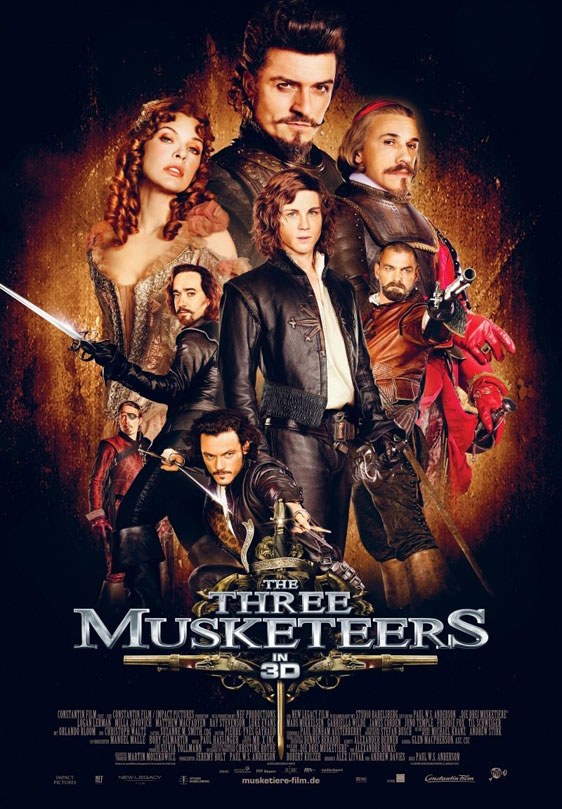
A look back at an OK one - The Three Musketeers


It seems that Alexandre Dumas' The Three Musketeers has had something of a renaissance of popularity in recent years. Though, it is a stupendous classic novel, so that is hardly surprising. Back in 2011, the story was given a new cinematic reboot, and it remains the latest attempt to drag the Musketeers into the 21st century on the big screen.

Often billed as a "steampunk version" of the tale, the film swiftly and at times savagely whirled through Dumas' tale, often with quite varied and awful results in my opinion.
One of the film's big selling points was that it was in 3D (yawn). If you sell a film as a big 3D movie, it needs to blow your socks off visually. Whilst the envisioning of the 17th century was stylish enough in its historical inaccuracy (an airship landing in 17th century Paris - I ask you?!) its effects and action sequences were no more than ordinary for a film of this type, often venturing into the idiotic rather than dazzling in terms of its look.

This crop of characters are iconic, and throughout the centuries they have remained so, despite good and bad interpretations. Let's start with the Musketeers themselves. Logan Lerman as D'Artagnan. OK, yes I can see why they have done it (and comparatively his performance was not that awful) but for the most part it does not work; the end result not being bad so much as boring. Luke Evans and Ray Stevenson as Aramis and Porthos respectively just about work; they just about fit into their very basic character archetypes. Richard Macfadyen as Athos is an odd one. The best way I can describe my view of this performance is somewhere between so badly clichéd its brilliant, and so horribly cringe-worthy I can't look. When showing Athos as an action hero with a very cavalier attitude to everything, Macfadyen works, but the second any feeling or emotive reaction attempts to encroach, it all comes apart for me.

Strangely this whole weird blend of badly good/bad in a character presents itself again several times over. I reacted in a similar fashion to Freddie Fox's King Louis XIII, who's pompous foppish twittery is believable until he tries to show a human side, and to Orlando Bloom as the villainous Duke of Buckingham. In the latter case the pantomime antics, wooden clichés and  sheer bombardment of lunacy were so great that I really cannot decide if they were results of genius intention or a film-long string of unhappy cock ups.
Mads Mikkelsen is a complete and utter awful flop as Captain Rochefort, and  Juno Temple and Gabriella Wilde, whilst pretty as Queen Ann and Constance are quite forgettable the moment they go off screen and are nowhere near enough to convince as leading ladies. Milla Jovovich is indeed all the right amounts of sassy, sexy and charismatic, but there is not a second of film where she comes close to convincing as Milady de Winter, or even as any kind of villainess.

Solidly positive performances? Well James Corden provides reliable comic relief as Planchet, and the superb Christoph Waltz adds that much needed quality as the Cardinal Richelieu, but even he isn't enough to save this one.

I really do think that the minds behind this film did not spend enough time on the overall feel and end result of this film. Instead of which they seem to have simply thrown some big names and some striking effects at the plot and hoped for the best. It's a shame really; 2011's The Three Musketeers is at best an OK 110 minutes of escapism, but frankly I feel Dumas and his classic work deserves a bit more than that.


The Shoulder of Mutton


I have often frequented this quaint yet popular pub in the charming little village of Holcombe, so I thought it was high time I reviewed it. Ever the specifics though; I am choosing to review my most recent visit, which was today for lunch.

The positive elements are rather apparent from the off. The traditional atmosphere is cleverly preserved and maintained; the feel of the place is how a pub was and should be. Setting-wise it is clearly idyllic, even if you are inside. And when the food does come, it is of a good standard; no complaints about my Lancashire cheese and onion pie for instance.

I am a little frustrated though, because I know that the Shoulder clearly could excel and overtake its own potential. From simply being "nice" or "a good staple", the place could be so much more, if a few loose ends were tied up and a few negatives addressed.
Firstly, though of course I understand the need for bookings and reservations in these places in order for them to survive (and don't get me wrong - I am very glad the Shoulder is surviving). But when these do occur, staff should not harry and hurry any other patrons into far-flung corners and bunch them up together like cattle, almost forgetting them entirely. It is common service sense that every customer should be made to feel equally welcome and valued, and that just did not happen. Also on the subject of staff, those at the Shoulder  might want to be a bit more attentive to the needs and orders of their customers, rather than spinning plates and trays around at the bar for their own amusement. Yes they were polite enough, but several simple yet glaring errors were made that could be so easily avoided if the staff actually listened and engaged with customers, rather than sweeping through them and trying to cover their ineptitude with idiotic laughter and swagger.

Whilst the quality and taste of the food is without fault as far as I can see, the way in which it is presented did occasionally tend to veer into the ridiculous. For instance, all the lunchtime sandwich orders were presented in a small crate. An actual wooden crate, filled with bread, filling and salad. Whilst some chefs may feel in theory this is different and tasteful; in reality to me it just feels like an unnecessary gimmick, not to mention a struggle for a certain highly cultured and culinary authoritative, yet also elderly lady who was accompanying me.

I am certainly not denying that my most recent visit to the Shoulder was good, and I shall probably be revisiting at some point. I just wish they'd get their act together a bit more, as I say I know the potential is there.